Peddinghaus punches and dies, U.S. style
U.S. Style Punches and Dies
Technical Data
Triple Tool Assembly to suit FPDB Lines
| tools | left hand | center |
| punch no. | 272 | 292 |
| die no. | 271 | 291 |
| Ø max. mm | 32.0 | 44.0 |
All performance data refers to a material strength of 450 N/mm². Subject to design changes.
for use on Peddinghaus CNC punching lines AFPS AFCPS APS FPDB FPB FPD 1120 F-1170
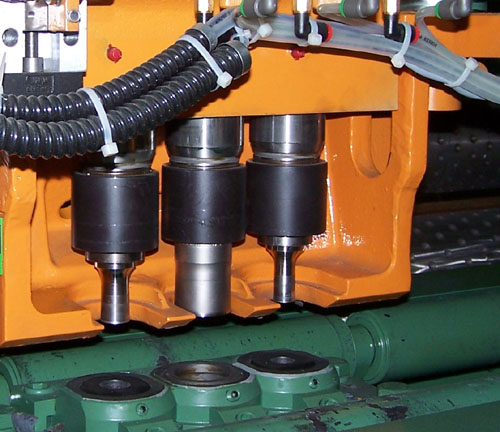
Applications in steel construction
Punches and dies to the U.S. standard are the tool pairs for punching machines that create the actual hole in the workpiece. The punch presses the material into the matching die, whose cutting edge shears the hole pattern cleanly. The U.S.-standard design concerns the dimensions and tool mounts, so that the tools fit machines with the corresponding mounting system.
Typical applications
- Punching structural steel, flat steel and plates on punching machines
- Producing round and shaped openings for bolted connections
- Working hole patterns into gusset plates and connection parts
- Tool changes for different hole diameters and material thicknesses
- Replacing worn punch-and-die pairs to maintain hole quality
Which businesses use it
Used in steel and metal fabrication, in locksmith shops and in businesses that work structural steel on punching machines.
Frequently asked questions
What is the difference between a punch and a die?
The punch is the upper, pressing tool; the die is the lower counterpart with the cutting opening. During punching the punch pushes the material through the die, whose edge shears the hole. Together they form a matched pair with the appropriate cutting clearance.
What does U.S. standard mean for punches and dies?
The U.S. standard refers to the standardised dimensions and mounts of the tools. It ensures that punch and die fit punching machines with the corresponding mounting system, in contrast to differing European designs.
Why must the cutting clearance between punch and die be correct?
The cutting clearance depends on the material type and plate thickness. If chosen incorrectly, burrs, break-outs or increased wear occur. A properly matched punch-and-die pair delivers a clean hole and a longer tool service life.