Peddinghaus punching machine Duplex
Portable Punching Machine
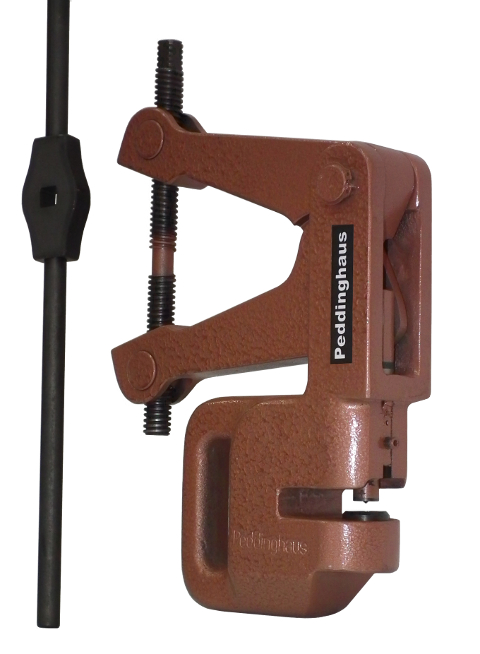
Technical Data
| Model | 27 / 250 | |
| part no. | 21323 | |
| punches | up to mm | Ø 17 in 12 |
| throat depth | mm | 50 |
| rated punching capacity | kN | 250 |
| net weight | kg | 19 |
| supplied with tools mounted: | part no. | |
| round punch no. 75 | Ø 17.0mm | 62075 1170 |
| round die no. 75 | Ø 17.7mm | 62275 1177 |
All performance data refers to a material strength of 450 N/mm². Subject to design changes.
Scope of Delivery
- frame with carrying handle
- pressure arms of special steel
- powerful lead screw
- two-arm wrench
- high punching capacity achieved by means of a screw transmission with a bell crank system
- exchangeable punches and dies
All capacities refer to material with a tensile strength of 450 N/mm2. We reserve the right to make design alterations without notice.
rugged, portable punching machine for punching rolled sections, rails and plate
The punching machine can be used on difficult access sites as well as in a stationary position (clamped in a vice).
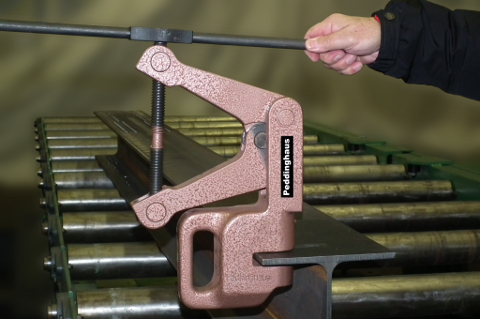
Applications in steel construction
The Duplex punch is a manually operated punching machine for producing round holes in flat steel, angle steel and structural sections without drilling. It is used wherever single holes for bolted connections need to be set quickly and without chips, on site or in the workshop. Punching cold-forms the material and delivers a clean, dimensionally accurate hole in a single operation.
Typical applications
- Punching flat steel and strip steel for bolted and riveted connections
- Setting connection holes in angle steel and sections without a drill
- Producing simple hole patterns in cleats, gusset plates and connecting parts
- Assembly and repair work on site without electrical power
- Reworking and adding single holes in existing steel parts
Which businesses use it
Used in structural steelwork, metal fabrication, locksmithing and assembly work where single holes must be set without a drill.
Frequently asked questions
What is the difference between punching and drilling?
When punching, the material is cold-separated by a cutting tool consisting of punch and die, without chips and without heating. This is significantly faster than drilling in a single operation and requires no power, but is suited to single holes up to a material-dependent limit.
Which workpieces can be processed with the Duplex punch?
Typical are flat steel, strip steel as well as angle steel and structural sections. The maximum hole diameter depends on the material thickness and strength; thinner plates allow larger holes than thick, high-strength sections.
Does the tool have to match the hole?
Yes. Punch and die form a matched pair for the respective hole diameter. For other diameters the appropriate tool is fitted so that cutting clearance and hole quality are correct.