Peddinghaus Flange Punching in UNP Channels
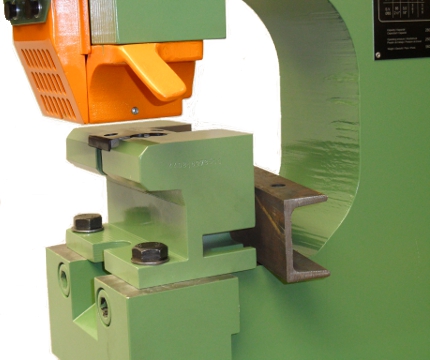
Punching in the flange of UNP 80 channel
Technical Data
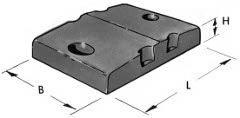
| offset taper die die no. 77 | ||
| L = | 90mm | |
| B = | 60mm | |
| H = | 11.3mm | |
All performance data refers to a material strength of 450 N/mm². Subject to design changes.
- flange-type die holder for UNP 80+100 channel
- part no. 44081 6 2735 11
Punching machine model Hydraulic 280 equipped with quick-change punching attachment, flange-type die holder and offset taper die no. 77
for punching in the flange of UNP 80 channel:
for punching holes up to 22mm Ø, oblong holes up to 26mm length
Applications in steel construction
Flange punching in UNP sections is used to make holes in the flanges of channel sections without deforming the section's cross-section. In structural steelwork these holes are needed for bolted connections on beams, purlins and joints. A suitable tool and saddle holder guides the punch cleanly through the flange of the section.
Typical applications
- Punching the flanges of UNP sections for bolted connections
- Preparing beam and purlin connections in structural steelwork
- Producing hole patterns for splice and cleat connections
- Machining channel sections for assembly and prefabrication
- Dimensionally accurate holes in structural steel without drilling
Which businesses use it
Flange punching in UNP is used above all in structural steelwork and metalworking as well as in steel trading and contract manufacturing for section machining.
Frequently asked questions
Why punch the flange of a UNP section instead of drilling it?
Punching produces the hole in a single stroke and is faster than drilling for recurring hole patterns. With the right tool holder, the section's cross-section remains undeformed and the hole position dimensionally accurate.
What is flange punching in channel sections used for?
The holes in the flanges are used for bolted connections, for example on beam connections, purlins, splices and cleats. A uniform hole pattern is a prerequisite for an accurate fit during assembly.